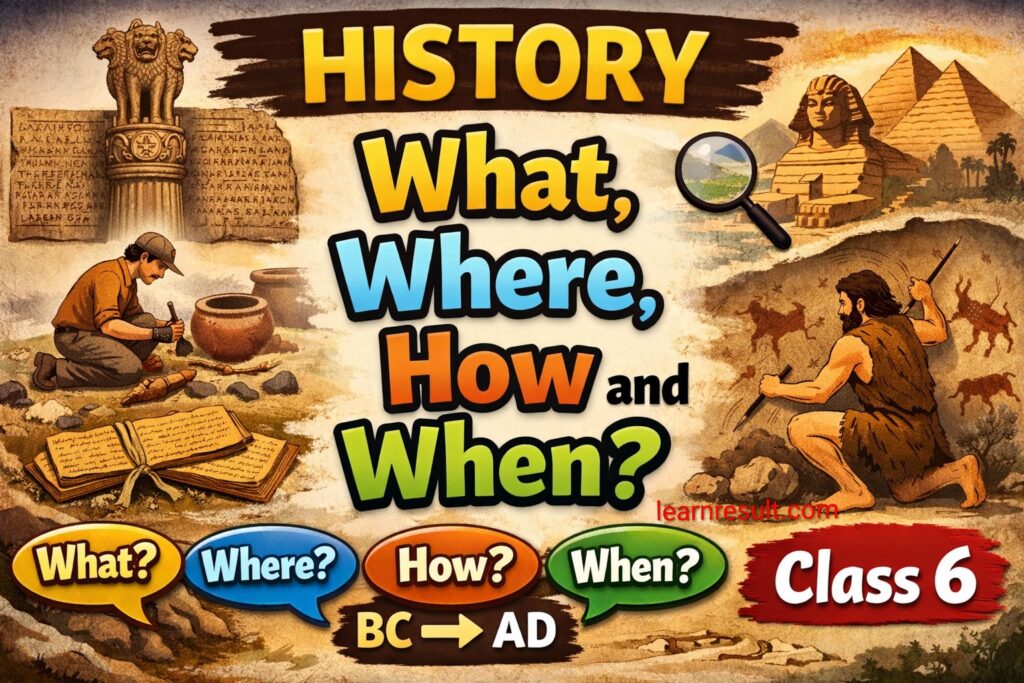
In this blog, we explain the Class 6 NCERT History chapter “What, Where, How and When?” in an easy and student-friendly way. You will learn what history is, where early people lived, how we know about the past through sources like manuscripts and inscriptions, and how time is divided into BC and AD. This blog is helpful for Class 6 students, teachers, and parents looking for clear explanations and exam-oriented notes.
Introduction
History helps us understand how people lived in the past and how human life changed over time. The Class 6 History chapter “What, Where, How and When?” from Our Pasts–I, published by NCERT, introduces students to the basics of history by answering four simple but important questions: What happened? Where did it happen? How do we know about it? And when did it happen?
What – What did people do in the past?
In ancient times, people lived very differently from today. Early humans hunted animals and gathered fruits and roots for food. Over time, they learned to grow crops and domesticate animals. Slowly, villages, towns, and cities developed. People also began to make tools, write books, build houses, and form kingdoms. All these activities together form an important part of history.
Where – Where did people live?
Most early settlements grew near rivers. Rivers provided water for drinking, fertile soil for farming, and easy routes for travel and trade. Civilizations like the Indus Valley Civilization developed along rivers. Powerful kingdoms such as Magadha also flourished near river valleys. This shows how geography played a key role in shaping human life.
How – How do we know about the past?
We learn about the past through different sources of history:
- Manuscripts: These are hand-written books made on palm leaves or birch bark. They tell us about religion, education, and daily life.
- Inscriptions: These are writings engraved on stones, pillars, or walls. Many inscriptions contain orders and messages of kings, such as those of Emperor Ashoka.
- Archaeology: Archaeologists dig the ground to find tools, pottery, houses, coins, and bones. These objects help us understand how people lived long ago.
When – When did events happen?
Time is very important in history. Historians divide time into two main parts:
BC (Before Christ) – Events that happened before the birth of Jesus Christ.
AD (Anno Domini) – Events that happened after his birth.
This system helps us arrange historical events in the correct order and understand how old or recent they are.
Conclusion
The chapter What, Where, How and When? helps students understand the foundation of history. It explains what history is, where early people lived, how historians study the past, and how time is measured. By learning this chapter, students build a strong base to explore ancient civilizations and historical events in later chapters.
✅ MCQs (Multiple Choice Questions)📚📚 ❓
1. History is the study of:
- A. Future events
- B. Present time
- C. Past events
- D. Natural science
✔ Answer: C
2. Which source is hand-written?
- A. Inscription
- B. Manuscript
- C. Coin
- D. Tool
✔ Answer: B
3. Early people mostly lived near rivers because:
- A. Rivers looked beautiful
- B. Rivers provided water and fertile land
- C. Rivers were dangerous
- D. Rivers were far from forests
✔ Answer: B
4. Writings carved on stone are called:
- A. Manuscripts
- B. Paintings
- C. Inscriptions
- D. Books
✔ Answer: C
5. BC stands for:
- A. Before Century
- B. Before Christ
- C. Beyond Christ
- D. Birth of Christ
✔ Answer: B
📚📚 Very Short Answer Questions✅ ❓
1. What is history?
✅ ➡️ History is the study of the past.
2. Name one source of history.
✅ ➡️ Manuscripts.
3. On what were manuscripts written?
✅ ➡️ Palm leaves and birch bark.
4. Who studies material remains of the past?
✅ ➡️ Archaeologists.
Short Answer Questions 📚 📖 ✅❓
1. Why did people live near rivers in the past?
✅ ➡️ People lived near rivers because rivers provided water for drinking, fertile land for farming, and easy routes for travel and trade.
2. What are inscriptions?
✅ ➡️ Inscriptions are writings engraved on stone or metal surfaces. They usually contain orders and messages of kings.
3. What do manuscripts tell us?
✅ ➡️ Manuscripts tell us about religion, education, customs, and daily life of people in the past.
Long Answer Questions 📚📖 ✅ ❓
1. How do historians know about the past?
✅ ➡️ Historians know about the past through manuscripts, inscriptions, and archaeological remains. Manuscripts give written information, inscriptions provide royal orders, and archaeology helps us understand daily life through tools, houses, and coins found during excavations.
2. Explain BC and AD.
✅ ➡️ BC means Before Christ and refers to the period before the birth of Jesus Christ. AD means Anno Domini and refers to the period after his birth. This system helps historians arrange events in chronological order.
We hope that you have clearly understood all the information explained by us. For more information, please visit our website. Learn Result
Thank you.